
The Math Behind Matching Card Games Like Spot It and Dobble
Why do any two Spot It or Dobble cards always share exactly one symbol? The answer is finite projective planes — and it's why custom matching games like PairPops work at all.
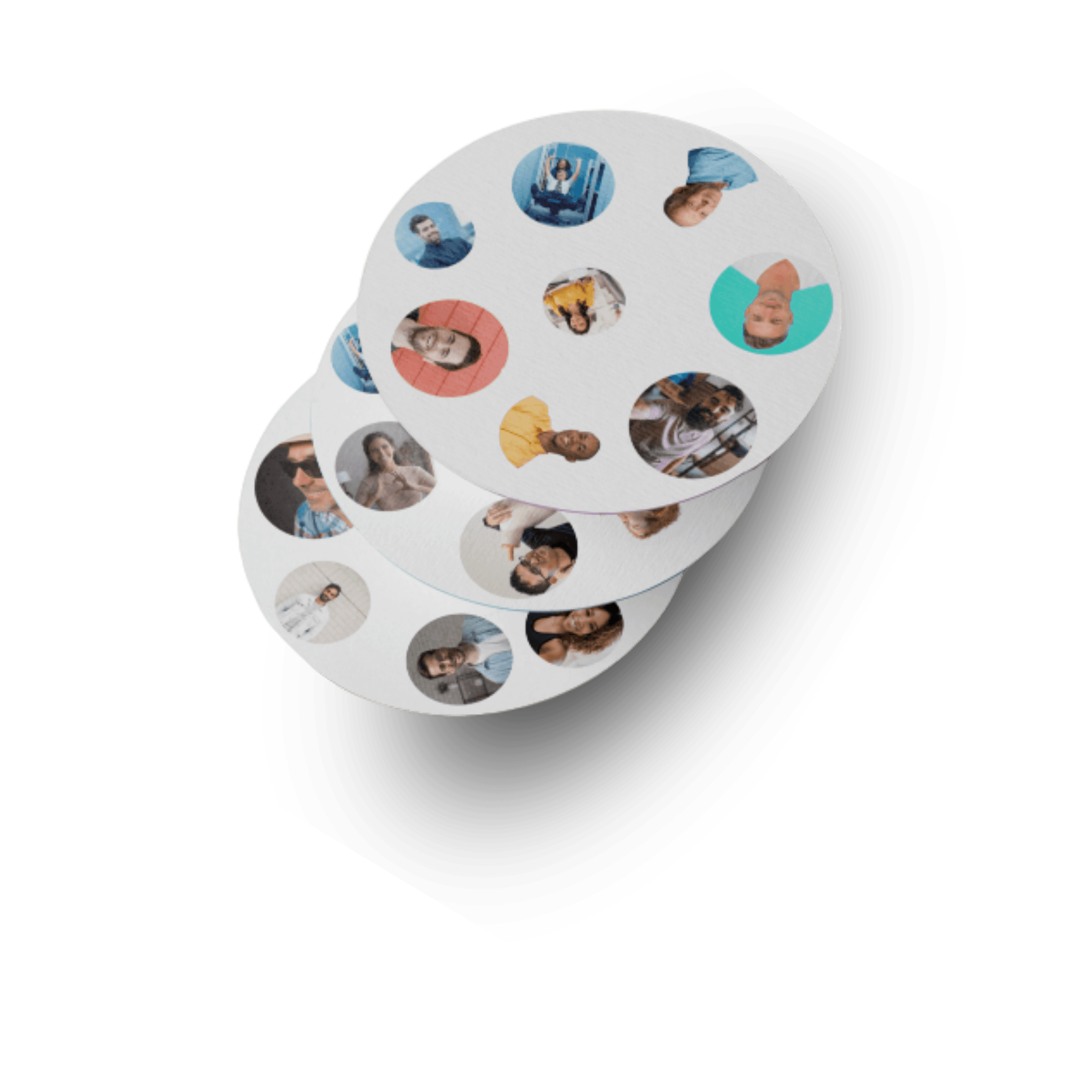
Pick up any two cards from a deck of Spot It or Dobble. Flip them face up. No matter which two you chose, they share exactly one matching symbol — never zero, never two, always one. Do it a hundred times. The result never changes.
This isn't a coincidence, and nobody hand-placed the symbols to make it work. It's a consequence of a branch of mathematics called finite projective geometry. Once you see how it works, the game looks completely different.
The Numbers Behind Spot It and Dobble
The full mathematical structure behind Spot It and Dobble is built on these numbers:
- 57 total symbols in the complete symbol set
- 8 symbols per card
- 57 cards in the complete mathematical deck
- Any two cards share exactly 1 symbol — always, guaranteed
The commercial version of Spot It ships with 55 cards (two are left out of the full 57-card set). Dobble, the European name for the same game, also ships 55. The underlying math works for all 57, but a 55-card deck is easier to package and still fully playable — removing two cards doesn't break the one-match property for the remaining 55.
What Is a Finite Projective Plane?
In ordinary (Euclidean) geometry, two lines either intersect at exactly one point, or they're parallel and never meet. Projective geometry removes the parallel exception: in a projective plane, every two lines intersect at exactly one point, always.
A finite projective plane is one with a finite number of points and lines. These structures are described by a number called the order of the plane, written n. For any projective plane of order n:
- The plane has n² + n + 1 points
- The plane has n² + n + 1 lines
- Each line contains n + 1 points
- Each point lies on n + 1 lines
- Any two distinct lines share exactly 1 point
Now substitute "symbol" for "point" and "card" for "line." The structure hands you a card game where any two cards share exactly one symbol — by geometry, not by arrangement.
Why 57? The Order-7 Projective Plane
Spot It and Dobble use the projective plane of order 7. Plug n = 7 into the formulas:
- n² + n + 1 = 49 + 7 + 1 = 57 symbols
- n² + n + 1 = 57 cards
- n + 1 = 8 symbols per card
Finite projective planes are only proven to exist for orders that are prime powers: 2, 3, 4, 5, 7, 8, 9, 11, and so on. Order 7 is the smallest prime power that produces a deck large enough to be interesting as a party game. Order 4 gives only 21 cards with 5 symbols each — playable, but thin. Order 7 gives 57 cards with 8 symbols each — much richer, and still fast enough to scan at a glance.
How the One-Match Guarantee Works
Here is the key insight: in a projective plane, any two distinct lines intersect at exactly one point. When cards are lines and symbols are points, "any two cards share exactly one symbol" is not a rule someone enforced after the fact — it is a theorem that follows automatically from the definition of the projective plane.
Placing 57 symbols across 57 cards such that each card has exactly 8, and any two cards share exactly one, would be extraordinarily difficult to arrange by hand. The projective plane gives you the entire assignment for free. You substitute your own images into the positions the geometry already defined, and the guarantee holds automatically.
How the Deck Is Actually Constructed
Knowing that a projective plane exists is one thing. Actually building one — assigning which symbols go on which card — requires a concrete algorithm. The method used in real matching games relies on a branch of algebra called Galois field theory, named after the nineteenth-century mathematician Évariste Galois.
A Galois field (written GF(n)) is a finite set of numbers where you can add, subtract, multiply, and divide — and always get a result that stays within the set. Galois fields exist only when n is a prime power (2, 3, 4, 5, 7, 8, 9, 11…), which is exactly why matching games can only be built at those sizes. When n is not a prime power, no valid Galois field exists, and the construction fails.
The construction works in four steps:
- Choose an order n — a prime power. For Spot It / Dobble, n = 7.
- Represent each symbol as a coordinate in GF(n) × GF(n), plus one "point at infinity" per direction. This gives n² + n + 1 symbols total.
- Define each card as a line in that coordinate space. A line through GF(n) × GF(n) passes through exactly n + 1 points — so each card holds exactly n + 1 symbols.
- The one-match property falls out automatically. Any two lines in a projective plane intersect at exactly one point. Any two cards therefore share exactly one symbol, with no manual checking or trial-and-error required.
The output is a complete symbol-to-card assignment table for the entire deck. The math does all the layout work — you only need to substitute your chosen images into the positions the geometry already defined.
A Worked Example: The Smallest Possible Matching Game
The smallest valid matching game uses order n = 2. The resulting structure is called the Fano plane, first described by the Italian mathematician Gino Fano in 1892. Its numbers:
- n² + n + 1 = 4 + 2 + 1 = 7 symbols
- 7 cards
- n + 1 = 3 symbols per card
Label the seven symbols A through G. The complete valid card set is:
| Card | Symbols |
|---|---|
| 1 | A, B, C |
| 2 | A, D, E |
| 3 | A, F, G |
| 4 | B, D, F |
| 5 | B, E, G |
| 6 | C, D, G |
| 7 | C, E, F |
Pick any two cards. They share exactly one symbol — every time, without exception. Card 1 and Card 4 share B. Card 2 and Card 6 share D. Card 3 and Card 7 share F. This holds for all 21 possible pairs in the deck. Replace A–G with seven faces or logos, and you have a fully functional custom matching game.
This is also the theoretical lower bound: no valid matching game with fewer than 7 cards exists.
Can Any Number of Cards Work?
No. A valid matching game deck cannot be built for an arbitrary number of cards. The deck size must satisfy n² + n + 1 for some value of n that is a prime power.
Prime powers are numbers of the form pk where p is prime and k is a positive integer: 2, 3, 4, 5, 7, 8, 9, 11, 13, 16, 17… The number 6 is not a prime power (6 = 2 × 3), 10 is not (10 = 2 × 5), and 12 is not. For those values of n, no Galois field GF(n) exists, so the construction breaks down and no valid deck can be produced.
This means you cannot build a perfect matching game with, say, 50 cards and 50 symbols — 50 is not of the form n² + n + 1 for any prime-power n. The nearest valid deck sizes are 21 cards (n = 4) and 57 cards (n = 7). Choosing a non-conforming size produces a deck where some pairs of cards share zero matches and others share two, destroying the one-match guarantee.
Smaller and Larger Matching Games
The same construction works at other orders, producing matching games of different sizes:
- Order 2: 7 cards, 7 symbols, 3 per card — the smallest possible matching game
- Order 3: 13 cards, 13 symbols, 4 per card
- Order 4: 21 cards, 21 symbols, 5 per card
- Order 7: 57 cards, 57 symbols, 8 per card — Spot It / Dobble
- Order 11: 133 cards, 133 symbols, 12 per card
As order increases, the deck grows and each card becomes harder to scan quickly. Order 7 hits a sweet spot: large enough for a group game, small enough to find the match in under a second once you're practiced.
How PairPops Uses This Math
PairPops is a custom matching disc game built on the same finite projective plane structure. The difference is that you replace abstract symbols with your own photos — team headshots, wedding guests, family faces, company logos.
Because the one-match guarantee is mathematical rather than editorial, it holds for any set of images. Swap out symbols for faces and the geometry still applies: flip any two discs, and there is exactly one person who appears on both. The game works identically whether the symbols are colored shapes or your coworkers' headshots.
The circular disc format reinforces this: a radial layout makes it easy to scan all eight images at once, which is exactly the behavior the game rewards.
Want to see how the game plays in practice? The How It Works page walks through a full round. Ready to build a set with your own photos? Get a free mockup before you commit to a print run.
Frequently Asked Questions
Is Spot It the same as Dobble?
Yes. Dobble is the original European name; Spot It is the North American edition published by Asmodee. Same cards, same math, different packaging.
Why does commercial Spot It have 55 cards if the math gives 57?
The full order-7 projective plane produces 57 cards. The commercial game ships 55 — two are omitted for packaging reasons. Removing any two cards from the 57-card set does not break the one-match property for the remaining 55; any two of those 55 still share exactly one symbol.
Can you make a matching game with more cards?
Yes, by moving to a higher-order projective plane. Order 11 gives 133 cards with 12 symbols each. The trade-off is that scanning 12 images simultaneously is harder, and large custom print runs become expensive.
Does the one-match rule work for any images?
Yes. The images are labels placed into positions that the geometry already defined. The one-match guarantee comes from the structure of the projective plane, not from the content of the images.
What is the matching card game math called?
The branch of mathematics is called finite projective geometry, specifically the theory of finite projective planes. It sits at the intersection of combinatorics and geometry, and has applications well beyond card games — including error-correcting codes and experimental design in statistics.
Why can't a matching game have exactly 10 cards with 10 symbols each?
Because 10 is not a prime power. The construction requires a Galois field of order n, and Galois fields only exist for prime powers: 2, 3, 4, 5, 7, 8, 9, 11, and so on. The number 10 = 2 × 5 is a product of two distinct primes, not a prime power, so no valid GF(10) exists and the one-match guarantee cannot be constructed for that deck size. The nearest valid options are order 9 (91 cards, 10 per card) and order 7 (57 cards, 8 per card).
Can I generate a matching game deck with code?
Yes. The construction algorithm is straightforward to implement. The most common approach uses Python with a Galois field library (such as galois on PyPI) to perform the modular arithmetic and output the symbol-to-card assignment as a table. From there, the hard part is the visual layout — distributing images on circular cards in a way that is easy to scan at speed. That production step is what PairPops handles: you supply the photos, and we take care of the geometric layout, print, and fulfillment.